Ikebana: Why the Ancient Japanese Art of Flower Arranging Has Become a Modern Practice of Mindfulness
In an age that demands speed, multitasking, and constant productivity, more and more people are turning to practices that help them slow down. One of them is ikebana — the Japanese art of floral arrangement, which has existed for more than six centuries. Today, it is increasingly viewed not only as a form of decorative art, but also as a philosophy of attentive engagement with nature, space, and the creative process itself.
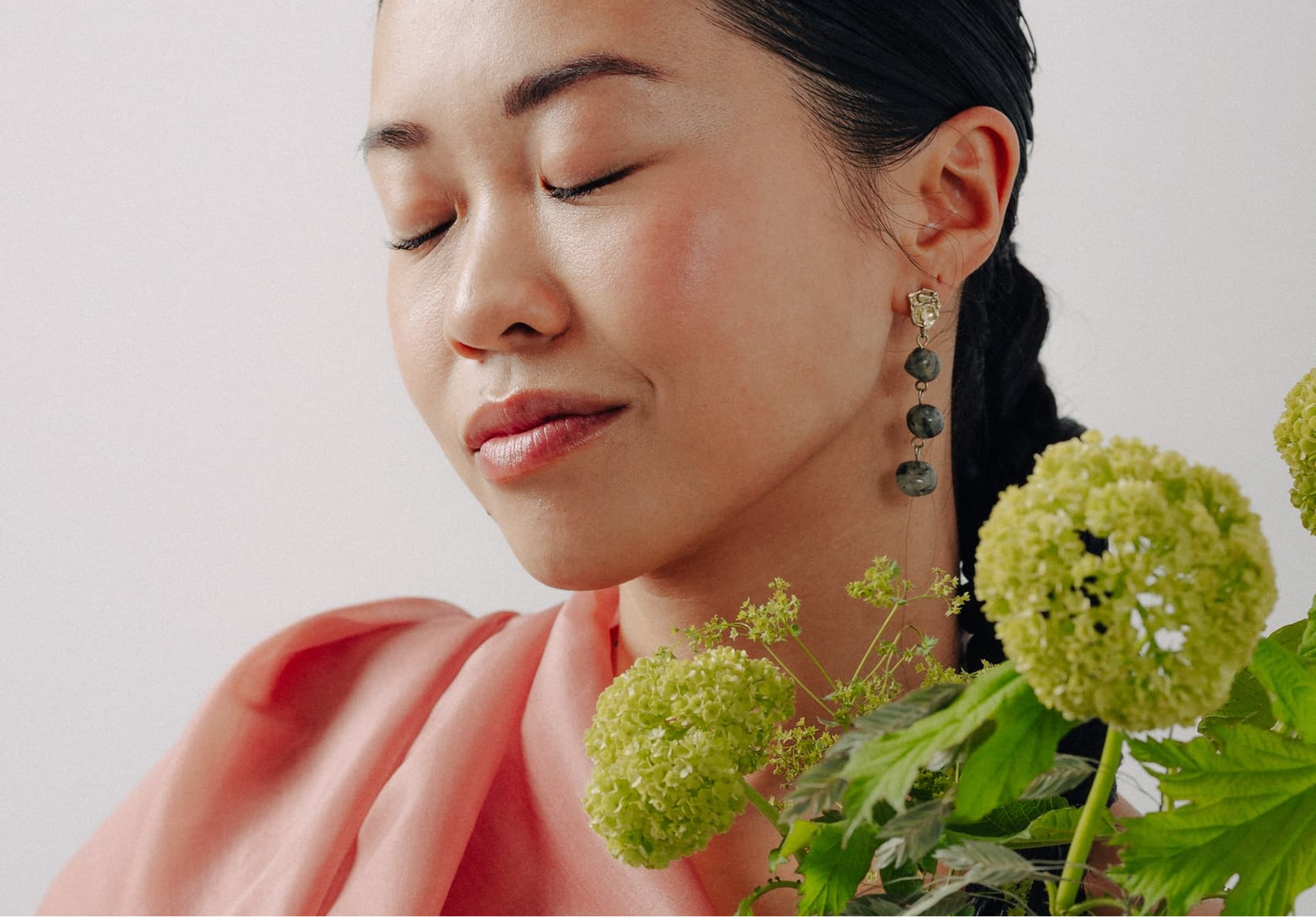
This idea lies at the heart of the editorial A Living Arrangement, where seasonal plants, natural materials, and handcraft come together within a single living space. Here, flowers are not merely decoration but active participants in the story, while the human figure does not dominate nature but becomes part of it.

Hat: Jarafin
Socks: Calzedonia
Shoes: Carvela
More Than a Bouquet
Although ikebana is often described as the art of arranging flowers, it actually has little in common with traditional European floristry.
While Western traditions tend to favour abundance and symmetry, the Japanese approach places emphasis on restraint, naturalness, and the space between elements. What is intentionally left empty is just as important as what is added to the composition.
Every branch, every curve of a stem, and every direction of a flower is chosen deliberately. The composition does not seek to fill the space — it learns to exist in dialogue with it.

Earrings: Glassworks
The Three Principles of Ikebana
Classical ikebana is structured around three main lines symbolising heaven, humanity, and earth. Their relationship reflects the idea of harmony between people and the world around them.
Other principles are equally important:
seasonality — plants are chosen according to the specific time of year;
asymmetry — nature is rarely perfectly symmetrical, and its beauty lies precisely in that imperfection;
space — emptiness is treated as an integral part of the composition, allowing each object to “breathe.”
These ideas can also be seen in contemporary photography, architecture, interior design, and fashion.

Earrings: Glassworks
When Nature Becomes a Co-Author
In Japanese culture, there is an idea that people do not create beauty from scratch — they simply help it reveal itself.
In A Living Arrangement, this concept becomes especially visible. Flowers do not function as decoration. They interact with the model, change alongside her, and require attention and care. The boundary between clothing, body, and plants gradually dissolves, transforming them into parts of one living system.
This approach is becoming increasingly present in contemporary fashion as well. Designers work with natural materials, artisanal techniques, and organic forms, seeking not to force nature into their vision but to collaborate with it.

Earrings: Glassworks
The Beauty of Imperfection
Ikebana is closely connected to a Japanese aesthetic in which naturalness is valued over perfection.
A curved stem, an unopened bud, or a branch with an unusual shape is not seen as a flaw but as part of the plant’s character. This is why arrangements often appear effortless and almost accidental, even though this apparent simplicity is supported by years of training and a deep understanding of proportion.
This perspective strongly resonates with contemporary ideas of beauty, where individuality, texture, and craftsmanship are increasingly valued.

Shoes: Carvela
The Art of Noticing
At the heart of ikebana is not the desire to control nature, but the ability to observe it closely. Before creating an arrangement, the artist studies the shape of the plant, the direction of its growth, the character of its leaves, and even the way light falls across them. The process begins not with action, but with observation.
This is precisely why ikebana remains relevant centuries later. It reminds us that beauty comes not only from skill, but also from the ability to pay attention to the world around us.
Perhaps this idea feels particularly contemporary today. Amid an endless flow of information and constant rush, the ability to notice the changing seasons, the shape of a branch, or the movement of light becomes more than an aesthetic experience — it becomes a way of rebuilding our relationship with space, nature, and time.
Photographer: Felix Quaedvlieg
Stylist: Rafin Jannat
MUAH: Ashya Ruesink
Model: Florence Liang