The Shape of Seeing
Why We Never See Ourselves or Others Objectively
We tend to imagine vision as something close to a camera: a person, object or reflection exists in front of us, and the brain simply records what is there. In reality, every act of looking already contains an interpretation. The way we perceive ourselves and those around us is shaped by memory, expectation, emotion, past experience and even by who happens to be looking at us in that moment.
That is why the same person can seem entirely different depending on the situation. Among people we know well, we notice certain things about ourselves; in a photograph, we see something else; in the mirror after a difficult day, something different again. The image itself may remain the same, but our attention is constantly rearranging it.

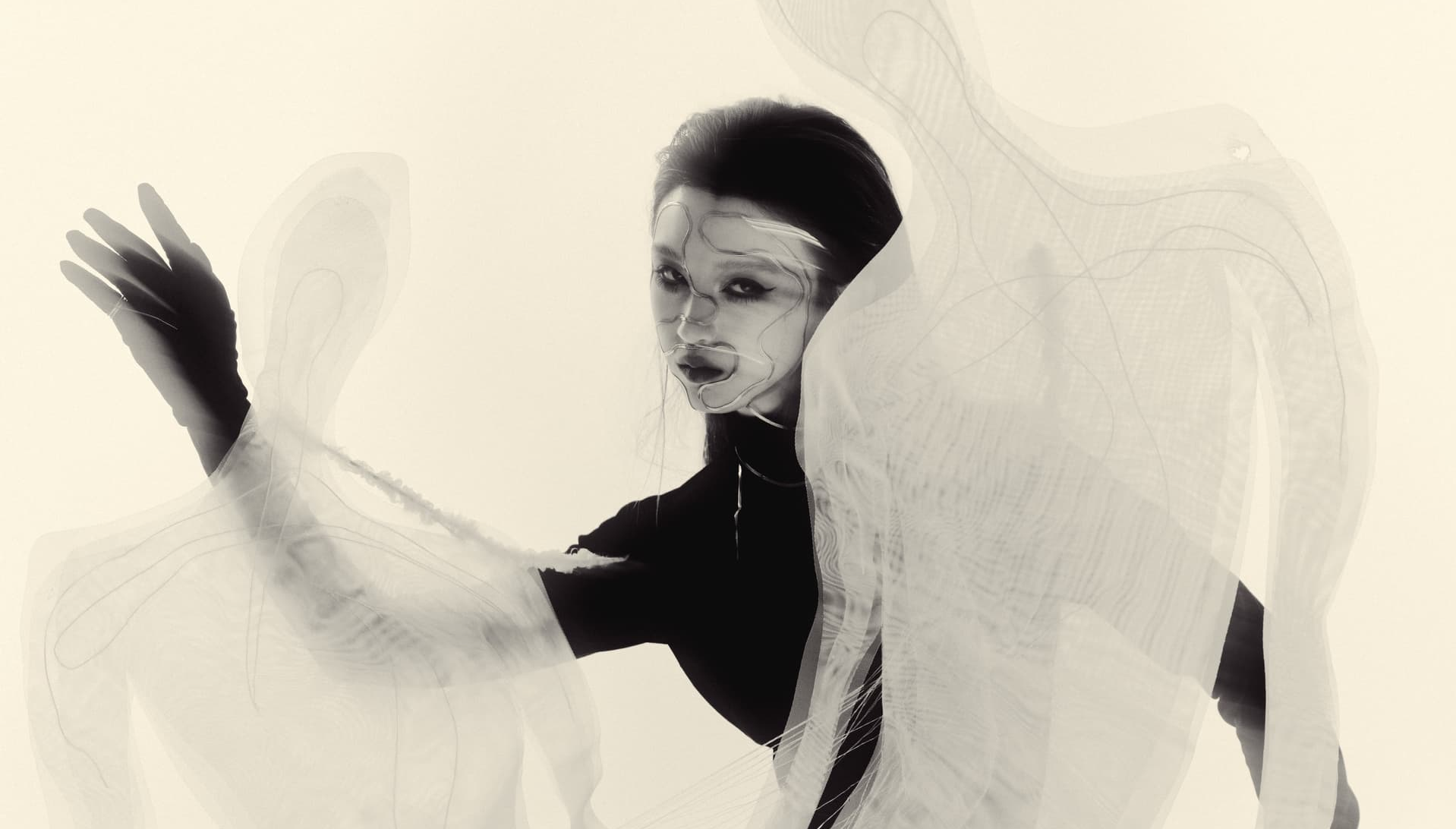
This idea becomes the starting point for the visual story The Shape of Seeing. Here, clothing quite literally refuses to remain static. Concealed magnetic fastenings allow fabric to open and gather back around the body, while layers of mesh create Moiré patterns that appear, sharpen for a moment and disappear again with the slightest shift in light or position.
The model moves in and out of translucent layers, sometimes hidden, sometimes visible again. At times, the garment defines the body; at others, it seems to dissolve its outline. As a result, it becomes difficult for the viewer to settle on a single “correct” form — it exists only in a particular moment and changes together with movement.

Human perception works in much the same way. We rarely see another person in their entirety. Attention selects certain details and the mind unconsciously fills in the rest. When we meet someone for the first time, we read their facial expression, clothes, gestures and voice, and within seconds begin to construct an idea of who they are — even though that idea is inevitably incomplete.
Our perception of ourselves is no more stable. Sometimes another person’s gaze, a comment or a photograph is enough to suddenly alter a familiar image. We begin to see ourselves through someone else’s eyes, and what seemed neutral only a moment ago takes on an entirely different meaning.

In The Shape of Seeing, this instability becomes a visual device. There is no final silhouette here, just as there is no final version of who we are in the eyes of others. The body, fabric, light and the viewer’s gaze are constantly shaping one another.
Perhaps this is why the attempt to see anything “as it really is” is almost always an illusion. We do not simply look at the world — with every gaze, we change it a little.


Model — Uri Sun
Makeup Artist — Joy Qiu
Photography Assistant — Ji Qi
Stylist & Fashion Designer — Yang Zeng