NAITE: Craft as a Map of the Journey
Three friends set out overland from Munich to Seoul, meeting craftspeople in the places where things are made and telling stories not only about the objects themselves, but also about the people, knowledge, and time behind them. In Uzbekistan, Naite discovered craft not as something preserved in a museum, but as a living part of everyday life.
NAITE & THE JOURNEY
To begin with, tell us about Naite. How did the project come about, and why did craft and the people behind it become a way of telling the story of your journey?
There are three of us, all in our early twenties. Theresa and Margareta are sisters from Germany, while Seop is from South Korea. We have always spent a lot of time in vintage and antique shops. Last year, we met Claudia and Reinhold Mari, who have been collecting and curating objects for more than fifty years and now run the Berlin shop Tischlein Schmück Dich.
It was their stories about objects and craft traditions that sparked our interest in documenting craftsmanship. A single object can contain an enormous amount of history, skill, and cultural identity, yet almost none of that is visible when you encounter it only in a shop or online. The people who preserve these traditions are often barely known outside their own communities. We called the project Naite — in Korean, it refers to the annual rings of a tree.
At the beginning of 2026, we started spending weekends visiting craftspeople in Germany and Austria. At first, we simply documented their work and tried making things together. We had barely begun this second part of the project when we decided to go on our journey, but the desire to continue documenting craft stayed with us.
You are travelling from Munich to Seoul through very different countries and cultures. How did the idea for this route come about, and what did you want to explore?
The journey itself originally existed separately from Naite. Theresa and Seop had talked for several years about travelling overland from one of their hometowns to the other and seeing everything in between. In April, rather spontaneously, we decided that this summer was the right time to do it.
As the route began to take shape, the scope of Naite naturally expanded. We thought: if we are already travelling, why not use the opportunity to visit craftspeople in their homes and workshops in person? We wanted not only to see well-known studios or museums, but to enter the spaces where craftspeople actually work every day.
We wanted to show the skills and the people behind the objects, so that viewers could see more than just their aesthetic value. Instagram may not be the perfect platform for that, but for us it is a good starting point, and over time we would like to explore longer formats.
As you travelled from one country to another, did you begin to notice connections between craft traditions that initially seemed completely different?
At first, we thought that every new country would open up an entirely separate world of craft. But the more workshops we visited, the more similar scenes we began to notice. The materials and the objects themselves may be completely different, but the tools, the atmosphere of the workshop, and even the stories of the craftspeople are often surprisingly similar.
It is especially interesting to see connections within the crafts themselves. Sometimes, in another country, we come across a pattern, material, or technique that reminds us of something we saw much earlier. Along the Silk Road in particular, it becomes very clear how craft traditions have influenced one another through trade, fashion, and migration over thousands of years.
At the same time, the differences do not disappear. To an untrained eye, carpets or other objects may look similar, but their visual language, symbols, materials, and purpose tell the story of a specific region. Local identity reveals itself in the details.


UZBEKISTAN
How did you meet the craftspeople in Uzbekistan? Were any of those encounters completely unexpected?
Uzbekistan has a very rich craft culture and it is relatively well documented, so finding craftspeople was easier than in some of the other countries on our route. We met many of them through Homo Faber, a platform dedicated to craftspeople.
Sometimes one craftsperson would quite literally lead us to the next. In Bukhara, we met gold embroiderer Nodir Rasulov, who took us to his friend, coppersmith Jurabek Sidikov, who then introduced us to his friend, miniaturist Davlat Toshev. These spontaneous connections became one of the most enjoyable parts of the journey.
But accessibility depends greatly on how well known the craftsperson is and on the scale of the local craft community. In Andijan, while trying to find ceramicist Mirzobakhrom Abduvakhkhobov, we first asked people in the craft district, then supermarket owners, and eventually one of them drove us directly to the house we were looking for. From the street, there was no way of knowing there was a workshop inside.


What did you find particularly distinctive about Uzbekistan’s craft traditions?
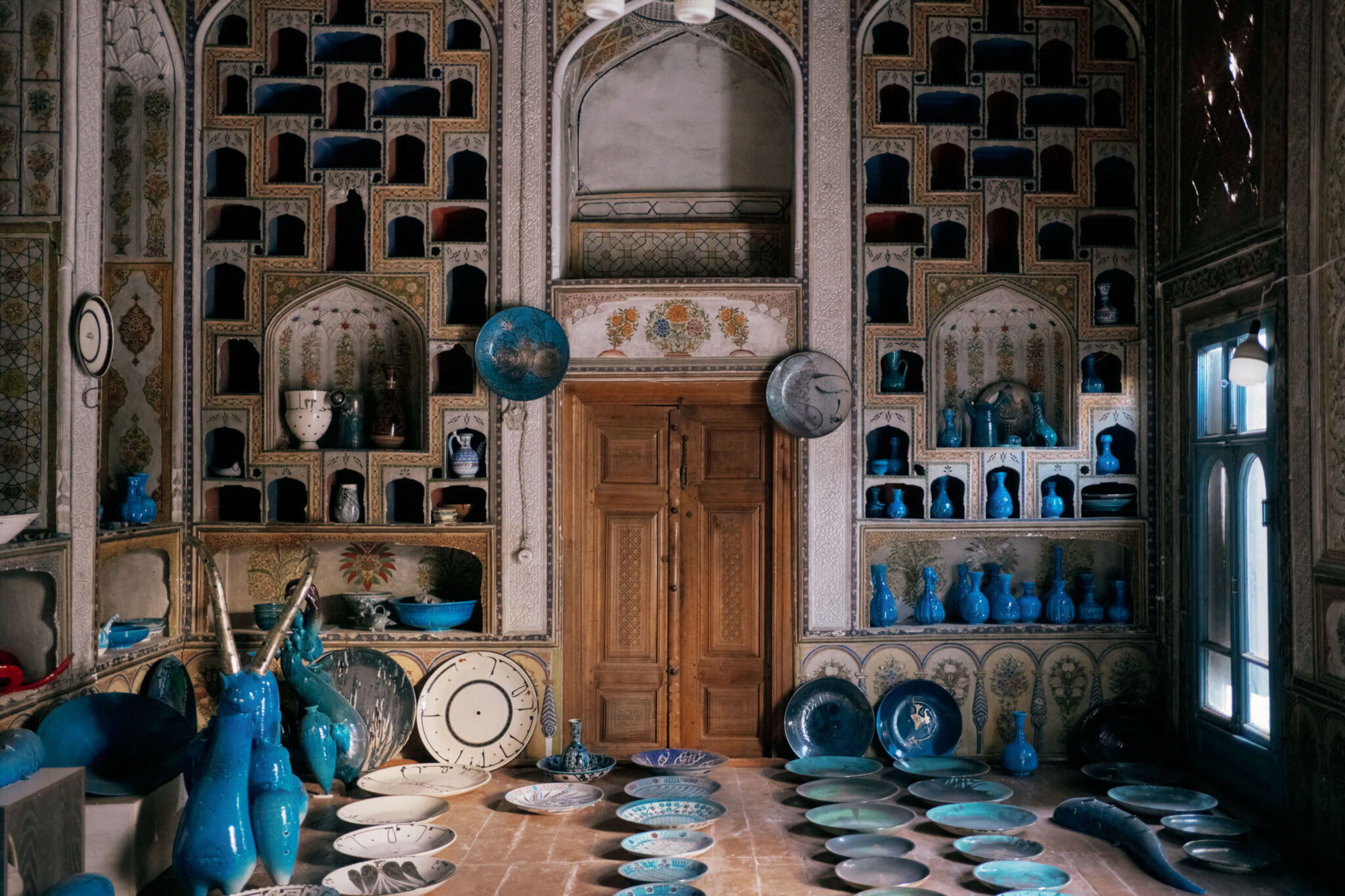
In many of the countries we visited before Uzbekistan, we had to make a deliberate effort to find craftspeople. Here, craft seemed to appear everywhere: in the tiles on buildings, in people’s clothing, in textiles and ceramics at the markets, and in the carved wooden details of houses.
What struck us was not so much one particular technique, but the density of the craft culture itself. Within a single city, ceramicists, metalworkers, woodcarvers, embroiderers, and weavers can all be working close to one another. Craft does not feel like something you have to actively search for, but like an ordinary part of the everyday landscape.
We also felt very strongly how visible the revival of craft traditions is here. It is easier for visitors to see craftspeople at work, buy their pieces, or attend a workshop or demonstration. Craft has become an important part of cultural tourism.
You spent time in craftspeople’s workshops and homes. What did those moments tell you about the people behind the craft?
At first, we mainly asked technical questions: what materials are used, who taught them the craft, how long it takes to make a single object. But after many encounters, we realised that the most memorable moments often happened in between the work.
We drank tea, listened to stories about families, and unexpectedly stayed for lunch. A craftsperson might spend more time with us than on their own work that day. The opportunity to see both someone’s work and their ordinary daily life at the same time became just as interesting to us as the objects themselves.
Almost every craftsperson spoke about their work with immense pride and dedication. Perhaps that is why Naite is increasingly becoming a project not only about craft, but also about people.

Among ceramics, woodcarving, textiles, and gold embroidery, which process surprised you the most?
It is difficult to choose just one. In a museum or a shop, the first thing you notice is the beauty, complexity, and precision of the finished object. In the workshop, the tools, the hands, and the endless repetition of a single movement come to the foreground.
We were particularly impressed by abrbandi, the Uzbek technique used to create ikat, which literally means “binding the clouds.” In Margilan, we met fourth-generation dye master Nurmuhammad Valiyev. The pattern is applied to grouped threads before the weaving even begins. Each colour requires the threads to be tied again by hand, dyed, dried, and then the already coloured sections protected once more. The preparation alone can take up to ten days before the actual weaving begins.
When you are filming, you become acutely aware that you are watching just a few seconds of a process the craftsperson has repeated for decades. There is something deeply humbling about that.


O‘zbekistondagi qaysi uchrashuv sizda eng kuchli taassurot qoldirdi?
Which encounter in Uzbekistan stayed with you the most?
Probably our meeting with ceramicist Mirzobakhrom Abduvakhkhobov in Andijan. His family has been working with ceramics for fifteen generations, and we found him almost by accident, after an entire day of searching and with the help of a local supermarket owner.
From the outside, it looked like an ordinary house, with nothing to suggest there was a workshop inside. Inside was a sunlit workspace, tools that had belonged to his father and grandfather, and a small private museum filled with ceramics from different decades — from pieces he made together with his father around fifty years ago to very recent works.
Of all the encounters, this one stayed with us in particular — both because of the continuity of the tradition and because of how personal the visit felt.


CRAFT & THE NEXT GENERATION
What did you learn about how craft knowledge is passed on in Uzbekistan today? Is the younger generation interested in continuing these traditions?
Before the trip, we assumed that skills were mainly passed down within families. But we discovered a much more developed system for preserving and teaching craft: masters take on young apprentices, and there are schools and institutions, such as the Crafts Development Centre in Margilan.
This was especially noticeable in Khiva, in the workshop of woodcarver Odamboy Masharipov. Around him were apprentices who usually stay for around ten years. He himself studied for more than twelve years before opening his own workshop, and he began teaching in that same year. There is even a specific term for the relationship between master and apprentice — “ustoz-shogird.” We felt that teaching the next generation is seen by craftspeople as just as important a responsibility as creating their own work.


Did these traditions feel like something being preserved from the past, or like something living, changing, and continuing to evolve?
Both. There is a clear process of recovering and preserving knowledge, some of which was almost lost during the Soviet period and has been actively researched and revived in recent decades.
But the craftspeople emphasised that even when working with traditional techniques, they are not simply reproducing the past. They experiment with materials and create new objects. Odamboy Masharipov, for example, developed a way of combining woodcarving with ceramics and received a presidential award for it. Nurmuhammad Valiyev weaves wool into adras to make the fabric warmer and better suited to contemporary pieces.
AFTER UZBEKISTAN
Did the journey change your perception of Uzbekistan?
A traveller is always limited in how much they can truly understand about a country. You can walk through cities and markets, see famous architecture, and still remain an outside observer.
Meeting craftspeople changed that feeling. Again and again, we were invited into spaces we would otherwise never have entered: small workshops and homes far from tourist areas. We sat with families, sometimes waited for a craftsperson to finish their work, and talked about all kinds of things.


What stayed with us in particular was how naturally tradition and contemporary life exist side by side. Someone working with a technique that is several centuries old could immediately take out their phone and show us photographs of their latest work. It felt much more alive and contemporary than the conventional idea of “traditional craft.”
Now, when we think of Uzbekistan, alongside mosques and markets, we first remember very personal scenes: someone’s courtyard, a workshop, a family, the tea we shared together. Without meeting the craftspeople, we would never have seen this side of the country.


What do you want people to see in your photographs beyond the beauty of the objects themselves?
Instagram is primarily a visual medium, so the image is the first hook. But we hope it makes people want to stay a little longer and ask: who made this object, how was it created, and what story lies behind it?
The project has also changed the way we look at things ourselves. Before, we too would first notice form, colour, and technical perfection. After spending time in workshops, it has become increasingly difficult to see a finished object separately from the person who created it.
When you know who made something, who taught the craftsperson, what materials and resources were used, and the environment they work in, the object begins to carry far more than what is visible on its surface.
If our photographs can make someone move beyond simply saying, “this is beautiful,” and instead ask, “who made this, and how?”, that would already mean a great deal to us.