

Visiting Dinara Kadyrova. Inside Tashkent’s Meros Gallery
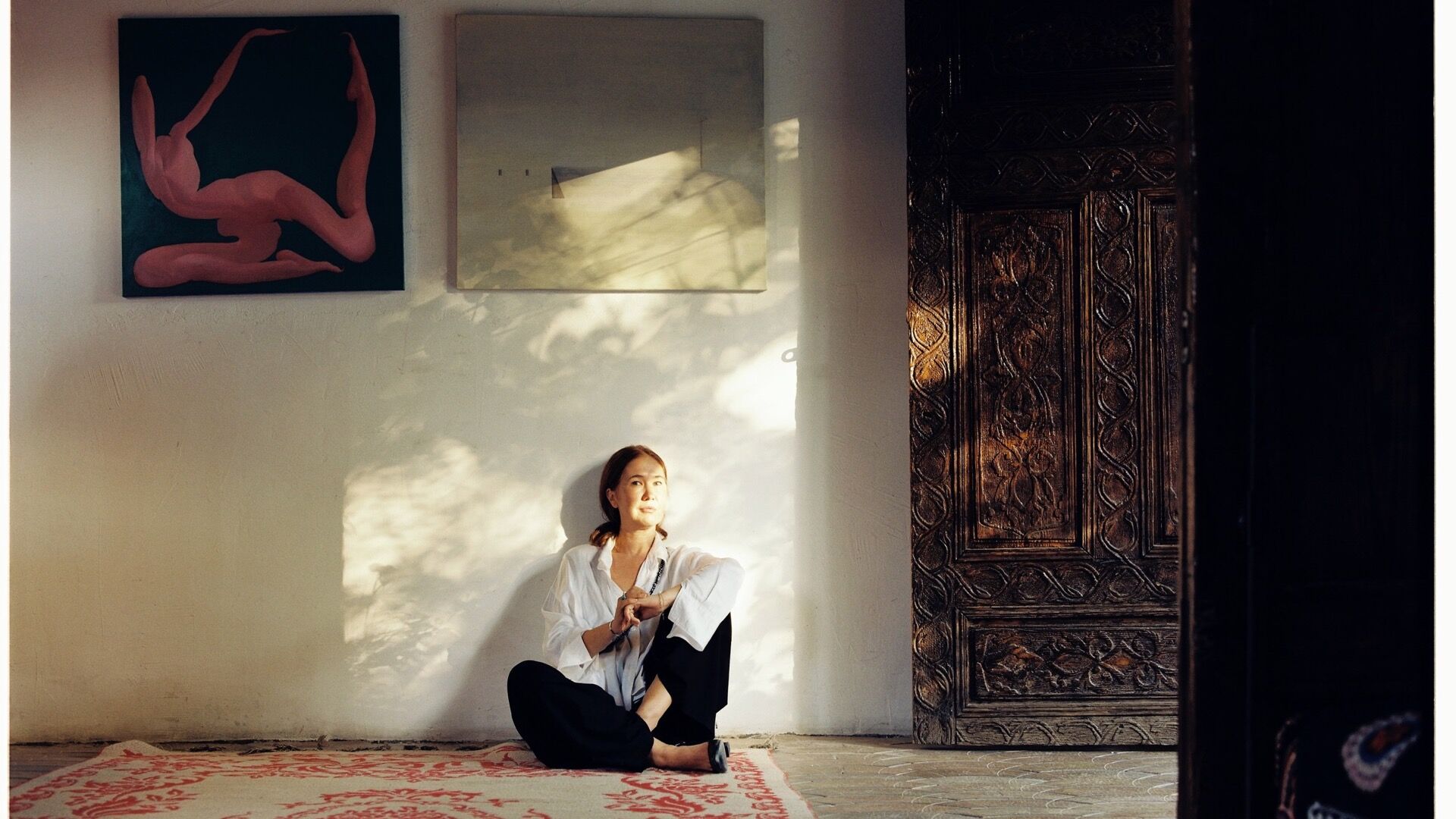
In central Tashkent, designer Dinara Kadyrova has opened Meros Gallery in a former private home. It hosts contemporary art exhibitions and intimate dinners, while the boutique offers pieces from Dinara’s own collection alongside vintage finds. ELLE Uzbekistan explores a gallery where visitors arrive by invitation or simply drop in for coffee.
The house that became a gallery
Dinara Kadyrova dreamed of having her own gallery as a child. By the time she returned to Tashkent after many years abroad, that dream had taken a tangible shape. Years of working with clothing and interiors had given Dinara her own view of what was worth preserving, how to combine different objects, and why a contemporary painting might belong in a room furnished with vintage pieces. All that remained was to find a house where she could bring it all together.

Meros occupies a former private home in the city centre. Its white façade now carries a sign with a name that means “heritage” in Uzbek. For Dinara, that word helped define the gallery’s purpose. She wanted objects that had once belonged to someone’s home or wardrobe to continue their lives in a new setting.
Behind the carved wooden door stands a counter faced with squares of powder pink, terracotta and green tile. On top sit a rotary telephone and a lamp with an orange shade. Even here, the principle behind Dinara’s furnishing of the house is clear. She collected objects gradually, allowing the interior to evolve as she found furniture, lamps and artworks.


The living room conveys the house’s former purpose particularly well. Pale drapery separates a striped sofa and a low table with a lace tablecloth from the rest of the room, while a large abstract work hangs above the sofa. One of the loveliest details is beside the fireplace. A mirror with a shaped wooden frame reflects terracotta curtains, their warm colour setting off the green glass vase on the mantelpiece. Two slender candlesticks stand nearby. Small combinations like these give each room its character.


Vintage for the home and wardrobe

In one photograph, Dinara rests her hand on a large black chess knight. A white one stands opposite, while the same combination of colours appears in the geometric composition on the wall behind her. There is something characteristic of Meros in this scene. The object attracts attention in its own right, but its proximity to a painting makes the chess piece look like a small sculpture.
When choosing vintage pieces, Dinara considers their quality, form and history. She is also interested in the place they might occupy in life today. This is especially easy to imagine in the tableware room, where a long table covered with a white cloth is devoted to the collection. Coloured pitchers stand among cups, saucers and clear glasses, with a blue vase of branches rising above them. Here, you can find a saucer from another service to match a favourite cup, or discover the piece that will begin a collection of your own.

The boutique reveals another side of Dinara’s work: her experience in fashion design. One rail holds jackets and dresses in warm terracotta and chocolate shades; on the next, the palette lightens to cream, lemon and muted green. Alongside vintage clothes are designs by Dinara Kadyrova herself, with jewellery and accessories laid out on a table in front of a mirror. Together they form the Meros wardrobe, where a contemporary piece can easily be paired with jewellery from another decade.

Art in the living room
From the boutique, a painting in the next room is visible through a glass partition.
From a distance, the eye picks up a combination of pink and green; walking from one room to the next offers a chance to examine the work more closely. At Meros, an encounter with art may begin just like this, even if the original reason for visiting was to try on clothes.
The gallery hosts group and solo exhibition projects, including an exhibition of works inspired by France. For Dinara, it matters that art remains part of the house’s everyday life between events. Visitors can return to a favourite painting, sit on the sofa opposite and see how it looks in a different light. A conversation that begins in the living room can then continue at a table in the courtyard.

France for an evening
Meros’s gastronomic programme has a name of its own: Gourmé. For its intimate dinners, the gallery brings together creative cuisine, music and art, paying as much attention to the table settings as to the interiors. In a house where tableware is chosen so carefully, a laid table becomes a natural extension of the collection. Only now, guests see glasses, plates and candlesticks in the very moment for which they were originally made.
One such evening was Gourmé Meros × France Fusion, devoted to French culture. Guests could explore an art exhibition and then gather for a dinner with a specially created menu and live saxophone music. For Meros, the value of this combination lies in the opportunity to spend an evening together: to look at the works, exchange impressions and linger at the table after the programme has ended.
A visit to Dinara
In its first year and a half, Meros Gallery welcomed more than five thousand people: Tashkent residents, members of the creative professions and visitors from abroad. Some came for an exhibition, some first discovered the space at a dinner, and others were looking for vintage finds in the city. Despite this number of visitors, the gallery has retained the intimacy of a private home, especially in the courtyard, where tables with white cloths stand beneath the trees.

For Dinara, the gallery remains a personal project, and perhaps the best way to get to know its owner is through the things she has chosen for the house. After walking through the rooms, you remember the carved door, the pair of chess knights and the green glass on the mantelpiece. In the final portrait by Shahlo Rahim, Dinara sits by a window with a cup in her hand. This could easily be an ordinary day at Meros, with no exhibition opening on the calendar but time to drop in for coffee.

Portrait photography — Shahlo Rahim
Interior photography — Yulia Makagon