

London Art Week: Frieze, a £31.56 Million Kandinsky and Anish Kapoor’s Return
Frieze’s fashion crowd, a £31.56 million Kandinsky, exceptional design at PAD and Anish Kapoor’s return to the Hayward. Four highlights from London’s October art calendar.
Every passion deserves its own space. This season, the art world had an entire city.
Frieze: London’s other Fashion Week
Fashion and art have long shared collaborators, references and audiences. Houses including Chanel, Louis Vuitton and Dior have invited artists into their creative worlds. During Frieze Week, that relationship finds another setting, with designers and their audiences joining the collectors and curators in the gallery aisles.
The clothes are part of the pleasure. An unexpected combination, a beautifully chosen accessory or a familiar face can catch the eye between stands. Frieze has developed a social rhythm recognisable to anyone who follows the fashion calendar, while retaining its own reasons for bringing people together.
According to the organisers, visitors across Frieze London and Frieze Masters included Tilda Swinton, Dries Van Noten, Raf Simons, Bianca Jagger, Andrew Garfield, Pedro Pascal, Daniel Craig and Graham Norton.

Fashion’s involvement also extends to the programme. Stone Island supports emerging galleries through Frieze Focus, Dunhill hosts the Frieze Masters Talks, and Jonathan Anderson marked the week with an exhibition at his Pimlico store. These partnerships give the relationship substance through funding, discussion and curation.
Together, Frieze London and Frieze Masters brought almost 300 galleries from 48 countries and regions to the capital, representing six continents. The reported sales reflected a similarly broad range of collecting interests.
At Frieze Masters, Loft Art Gallery sold Moroccan modernist Mohamed Melehi’s Untitled, 1967, for €180,000. A floral still life by Jan Brueghel the Elder, presented by Hauser & Wirth, went to a private collector for approximately £5 million. Three paintings by Alice Neel, shown by David Zwirner and Victoria Miro, achieved a combined $5 million.
The appeal lay in that breadth: a chance to encounter established masters alongside artists whose international recognition is still developing.
Christie’s: the story behind a £31.56 million Kandinsky
On 14 October, Wassily Kandinsky’s Das bunte Leben (La vie mélangée) became the most expensive lot across Christie’s London evening auctions. After almost six minutes of bidding, the painting sold for £31,560,000, including the buyer’s premium.

Painted in Paris in 1907, it occupies a significant place in Kandinsky’s development. As Christie’s observes, “this picture marks a major turning point in his oeuvre”.
The figures remain recognisable, yet colour is beginning to assert an expressive independence. Lovers, a mother and child, travellers, celebrations, conflict and a funeral procession share an imagined landscape. Each episode invites close attention, while the whole composition suggests the freedom of Kandinsky’s later work.
Its ownership history gives the auction result a deeper resonance. Acquired in 1927 by the Amsterdam collector Emanuel Albert Lewenstein, the painting later formed part of his family’s estate. In October 1940, following the German occupation of the Netherlands, it was sold at auction in circumstances that researchers have never fully reconstructed.
It subsequently spent decades on display at Munich’s Lenbachhaus, on loan from Bayerische Landesbank. In 2023, following a recommendation from Germany’s Advisory Commission on Nazi looted cultural property, it was restituted to the heirs.
Behind the public life of a celebrated painting was a family’s long search for what had been lost. In a 2017 interview with The Guardian, Robert Lewenstein’s daughter Francesca Davis described it as “a treasure that belongs to the world”.
PAD: the art of living with exceptional objects
Wool acquires sculptural volume; leather appears to flow. Materials associated with familiar uses take on unexpected delicacy or weight. At maison parisienne, Héléna Guy Lhomme presented a sculpture in carded wool inspired by Selene’s horse from the Parthenon. At Galerie Boketto, Thibault Philip’s translucent light was made from dried pig intestine, its fragile appearance giving little indication of its origin.
Such discoveries reward conversation with the galleries. An object’s surface offers the first impression; learning about its construction reveals the experimentation and judgement behind it.
Founded by Patrick Perrin in 2007, PAD London brings historical and contemporary design into company with fine art and jewellery. Works by Marc Chagall, Pablo Picasso, Andy Warhol, Tom Wesselmann and Alexander Calder formed part of the wider gallery presentations, through participants including Opera Gallery and Galerie von Vertes.
For visitors, the fair offers an opportunity to see these works within a single route. For collectors, it also provides a direct conversation about provenance, exhibition history and acquisition.
Two jury awards highlighted the enduring appeal of furniture as a collecting field. Meubles et Lumières received the Historical Design Prize for Flemming Agger’s Kronen sofa, created in 1967. Its generous, crownlike form comprises four padded fibreglass modules. According to PAD, two examples exist.


Jousse Entreprise won the Contemporary Design Prize for Marc Newson’s Chop Top Table, made circa 2006. Polished and lacquered aluminium meets glass in a piece whose carefully resolved construction gives it a distinctly sculptural presence.

Anish Kapoor: between wonder and unease
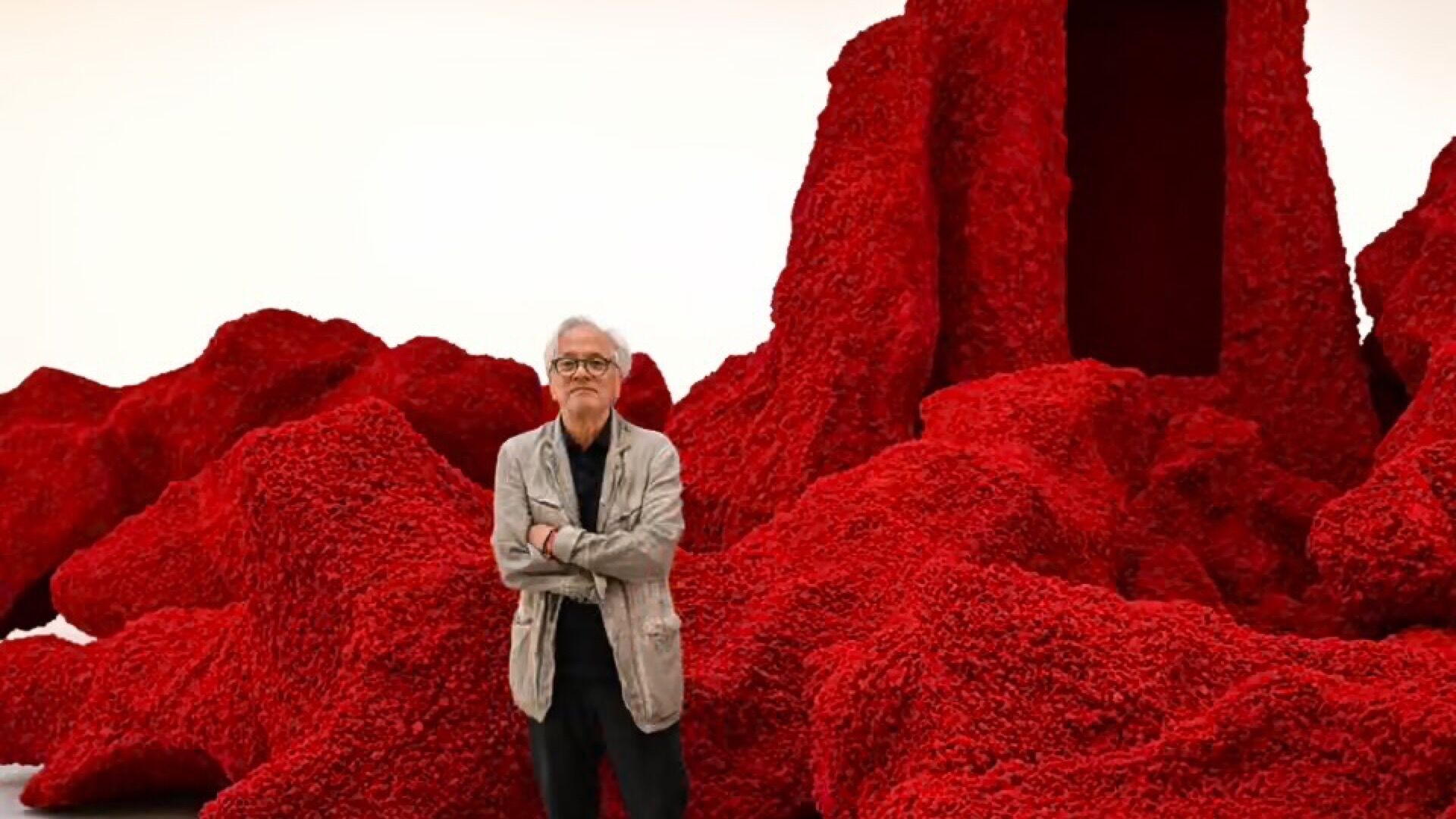
The close of Frieze Week on 18 October coincided with the final day of Anish Kapoor’s exhibition at the Hayward Gallery. Returning 28 years after his major presentation there in 1998, Kapoor filled the building with works that unsettled familiar relationships between body, object and space.
Saturated red surfaces, distorted reflections and monumental forms encouraged visitors to move, look again and reconsider their first impressions. Scale became something to experience physically.
Among the most arresting works was Mount Moriah at the Gate of the Ghetto, 2022, an immense inverted mountain suspended above the visitor. Its title invokes the biblical account of Abraham preparing to sacrifice his son Isaac on Mount Moriah, before an angel intervenes.
That reference lends the installation an emotional tension beyond its dimensions. The red surface suggests both geological matter and exposed flesh, bringing questions of faith, sacrifice and vulnerability into the encounter. Beneath the suspended form, admiration is accompanied by an awareness of one’s own fragile proportions.
It was a fitting final encounter in a week devoted to looking: a work whose presence required time, movement and attention.

London now passes the season on to Paris, where Art Basel is the next gathering point. November brings the inaugural Frieze Abu Dhabi, opening a new chapter for the fair in the Middle East. The cultural itinerary continues, carrying fashion, art and collecting into fresh company.